
Recycling Methods
Reconditioned on-site
which involves removing impurities from the used oil and using it again. While this form of recycling might not restore the oil to its original condition, it does prolong its life.
Inserted into a petroleum refinery
which involves introducing used oil as a feedstock into either the front-end of the process or the coker to produce gasoline and coke.
Re-refined
which involves treating used oil to remove impurities so that it can be used as a base stock for new lubricating oil. Re-refining prolongs the life of the oil resource indefinitely. This form of recycling is preferred because it closes the recycling loop by reusing the oil to make the same product that it was initially, and therefore uses less energy and less virgin oil.
Processed and burned for energy recovery
which involves removing water and particulates so that used oil can be burned as fuel to generate heat or to power industrial operations. This form of recycling is not as preferable as methods that reuse the material because it enables the oil to be reused only once. Nonetheless, valuable energy is provided (about the same as provided by normal heating oil).

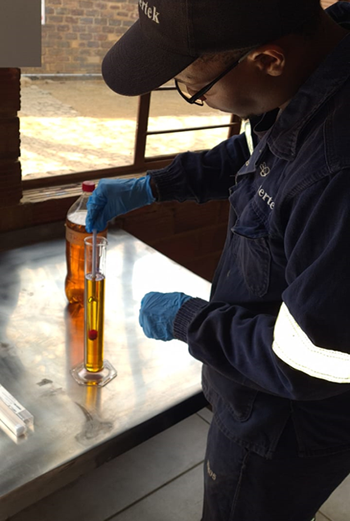
Used Oil - Sampling & Testing
All oils will be tested prior to acceptance for the following criteria (typical values shown):
- Viscosity
- Base number, tbc
- Density, 0,86 to 0,9
- Water content, 0 to 8%
- Flash point, 60 °C to 200 °C
- Solid content, 0 to 5%
Note:
In case of waste – transformer oils collected from high-risk sources the following must be provided.
- Metallic elements (As < 5ppm, Cd < 2ppm, Cr < 10ppm & lead < 100ppm)
- Halogen (F, Cl, Br, I) content < 1000ppm & PCB’s <50 ppm